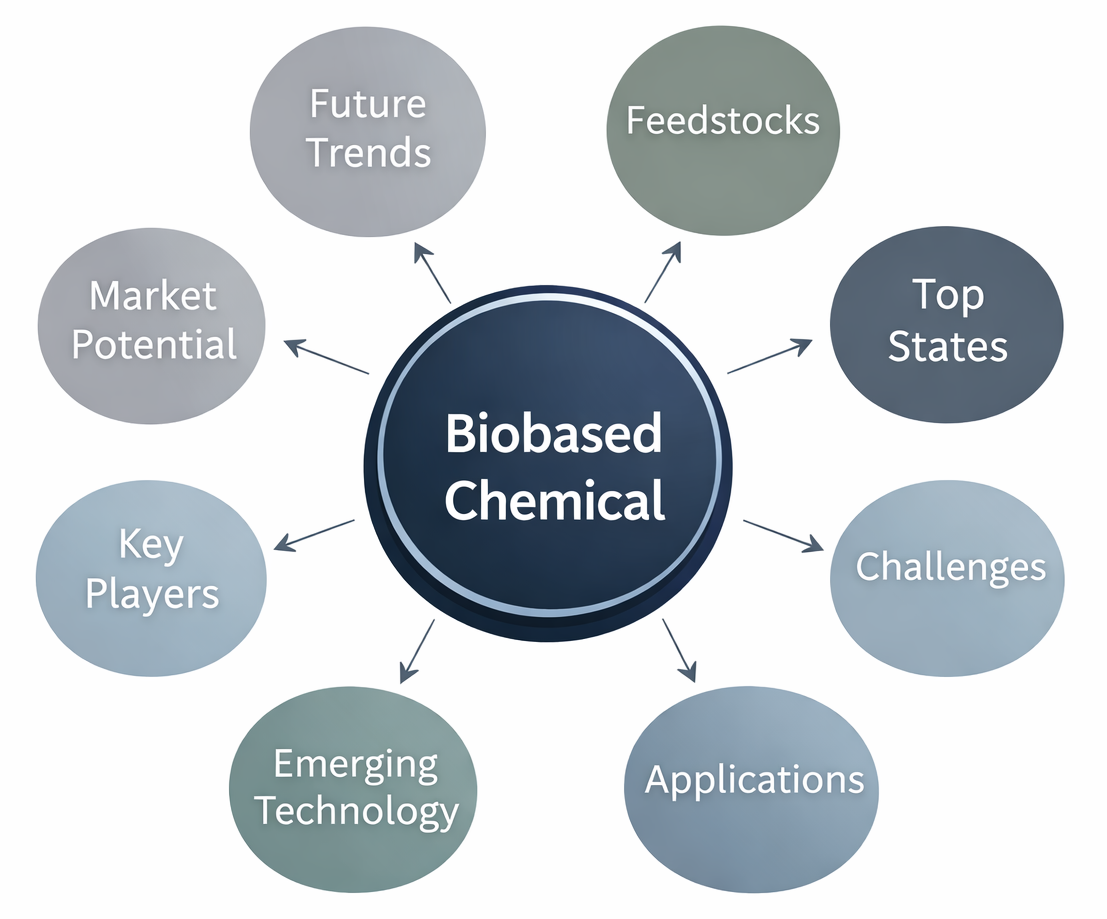
India Bio-based Chemicals: Market Potential, Costs, Companies, Technology
by ENERGIA VERDE SOLUTIONS | March 19, 2026 | Bio Products, Industrial Products, Insights
Key Questions Answered in this Section
- What is the estimated market size of bio-based chemicals in India as of 2023?
- What is the projected CAGR for the Indian bio-based chemicals market over the next five years?
- Which factors are driving the growth of the bio-based chemicals sector in India?
- Who are the key players in India's bio-based chemicals industry?
- What types of feedstocks are commonly used for producing bio-based chemicals?
- What are the primary end-use applications in the Indian market?
- How do government policies and initiatives support sector development?
- What challenges does the industry face regarding cost competitiveness and infrastructure?
- What emerging technologies and process innovations are influencing the sector?
- How much does it cost to set up a bio-based chemicals production facility in India?
- Which states in India are adopting bio-based chemicals the most?
This detailed report provides an in-depth analysis of the bio-based chemicals sector in India. It covers the current market landscape, growth potential, and key drivers shaping the industry. The potential is expanding rapidly due to rising demand for sustainable alternatives to traditional petrochemical products.
The report includes profiles of leading players, technological innovations, and the various feedstocks and processes involved in production. Additionally, it explores end-use applications, emerging trends, and challenges, offering valuable insights for stakeholders, investors, and policymakers interested in sustainable chemical solutions.
Table of Contents: Bio-based Chemicals Sector in India
- 1. Introduction
- 2. Market Overview and Potential
- 3. Key Players in the Bio-based Chemicals Sector
- 4. Technology & Processes for Bio-based Chemicals
- 5. Top 10 Bio-based Chemicals with Potential in India
- 6. Emerging Technologies and Process Innovations
- 7. Development Stages of Bio-based Chemicals
- 8. End-Use Applications of Bio-based Chemicals
- 9. Key Challenges
- 10. Key Stakeholders in the Ecosystem
- 11. Top 10 Bio-based Chemicals in India
- 12. Investment Landscape and Incentives
- 13. Conclusion
Market Overview and Potential of Bio-based Chemicals in India
Current State and Growth
- Market Size (2023): The Indian bio-based chemicals market is estimated at USD 1.5 billion and is currently in its nascent stage.
- 2028 Projection: The market is projected to reach USD 4–5 billion by 2028.
- Growth Rate: Anticipated CAGR of 15–20% over the next five years, fueled by increasing global demand for green chemicals.
Primary Growth Drivers
- Rising Sustainable Demand: Consumers are actively seeking eco-friendly alternatives to traditional petroleum-based products.
- Government Support: Supportive policies and national initiatives are promoting the adoption of bio-based manufacturing.
- Import Substitution: India aims to reduce heavy dependence on imported chemicals by incentivizing domestic bio-alternatives.
- Cost Competitiveness: Technological advancements are gradually closing the price gap between bio-based and traditional chemicals.
- Feedstock Availability: Proximity to abundant resources like sugarcane, corn, and agricultural residues drastically lowers production costs.
Key Players in the Bio-based Chemicals Sector (India)
Leading industrial groups like Godrej Industries and Praj Industries are spearheading the sector with eco-friendly products, while pioneering startups like String Bio are leveraging cutting-edge microbial technology to transform methane into high-value chemicals.
| Category |
Examples |
Role in the Sector |
Elaboration |
| Producers (Bio-based Chemical Manufacturers) |
Chemplast Sanmar, SRF Limited, Praj Industries |
Focus on higher-value chemicals like bio-plastics, bio-lubricants, and chemical intermediates. |
These companies play a crucial role in commercializing innovative alternatives to traditional petrochemicals. |
| Raw Material Suppliers |
Suppliers of rice straw, bagasse, corn stover, etc. |
Provide essential raw materials often sourced from agricultural residues or dedicated plantations. |
Sustainability of these raw materials is a crucial factor influencing the industry's long-term growth. |
| Enzyme & Culture Providers |
Organica Biotech, Enviro Tech Chemicals |
Develop and supply specialized microbial cultures and enzymes for bio-conversion. |
Essential for optimizing production by providing efficient, targeted biological catalysts. |
| Equipment Manufacturers (Biorefineries) |
Praj Industries, L&T, Godrej Process Equipment |
Manufacture specialized bioreactors and fermenters. |
Provides the technological backbone for scalable and efficient bio-based chemical production. |
| Technology Solution Providers |
Mecon Limited, Chemprojects |
Provide expertise in process design and engineering for biorefineries. |
Crucial in translating lab-scale processes into commercially viable and scalable industrial plants. |
Overview of Technology & Processes for Bio-based Chemicals in India
The production of bio-based chemicals in India utilizes a diverse range of feedstocks and conversion processes, each offering unique advantages and scalability potential.
Feedstocks
- Sugar-based: Utilizes Sugarcane Molasses for producing bio-based versions of everyday chemicals like bio-ethylene glycol, bio-butanol, and bio-acrylic acid.
- Starch-based: Corn is a primary source for producing bio-lactic acid, which serves as a critical building block for the bioplastics industry.
- Cellulosic (Agricultural Residues): Rice straw, wheat straw, and corn stover are being converted into platform chemicals like furfural and 5-hydroxymethylfurfural (HMF).
- Lignin & Algae: Emerging focus on Lignin for bio-aromatic chemicals and Algae for efficient biomass production and high-yield chemical conversion.
Conversion Processes
- Fermentation: Utilizing microorganisms (bacteria/yeast) to convert sugars into products like bio-lactic acid and bio-butanol, building on established bioethanol expertise.
- Hydrolysis: Breaking down complex biomass molecules into simpler sugars using water or enzymes to make them accessible for further conversion.
- Gasification: High-temperature conversion of biomass into syngas (synthetic gas), which can then be processed into various bio-based chemical streams.
- Direct Catalytic Conversion: An emerging technology that uses catalysts to bypass multiple stages, offering a more efficient and environmentally friendly production route.
Emerging Tech and Process Innovations in Top 10 Bio-based Chemicals
Advanced fermentation technology is driving the efficiency of bio-based chemical production in India, significantly reducing costs and improving commercial scalability.
1. Lactic Acid
- Consolidated Bioprocessing (CBP): Combining fermentation and downstream processing into a single step to improve overall efficiency.
- Enzyme Immobilization: Using solid supports for enzymes to allow for reuse and continuous fermentation.
- Key Example: Biocon (Bengaluru) is researching these techniques to enhance continuous lactic acid production from corn starch and sugarcane.
2. Succinic Acid
- Metabolic Engineering: Modifying microbial strains to improve yield and production efficiency via targeted genetic changes.
- Key Example: Jubilant Life Sciences (Noida) is engineering strains for improved yield from glucose sources.
- CBP Integration: Godavari Biorefineries (Mumbai) is integrating fermentation with downstream processing for agricultural residues like bagasse.
3. Bio-ethanol
- Cellulosic CBP: Integrating pre-treatment, hydrolysis, and fermentation into a single efficient step.
- Key Example: Indian Oil Corporation (Panipat) is utilizing rice and wheat straw for this integrated conversion process.
- Simultaneous Saccharification and Fermentation (SSF): Praj Industries (Pune) utilizes SSF to reduce process time and increase conversion efficiency from lignocellulosic materials.
4. Bio-ethylene glycol (Bio-MEG)
- Direct Catalytic Conversion: Bypassing the bio-ethanol intermediate stage by converting cellulosic biomass or syngas directly to Bio-MEG.
- Key Example: Reliance Industries (Jamnagar) is exploring catalytic technologies using wood chips and agricultural waste.
- Biocatalyst Engineering: Tata Chemicals (Mithapur) is developing efficient enzymes and whole-cell biocatalysts for direct conversion of forestry waste.
5. Bio-butanol
- Non-food Feedstock Utilization: Shifting away from corn to agricultural residues like corn stover and wheat straw to ensure food security.
- Key Example: Praj Industries (Pune) is researching sustainable bio-butanol production from sugarcane bagasse.
- Integrated Biorefinery Models: Co-producing bio-butanol with other biofuels from a single feedstock to maximize economic viability.
6. Bio-propylene glycol (Bio-PG)
- Alternative Feedstocks: Utilizing waste glycerol (biodiesel byproduct) and lignocellulose for broader sustainability.
- Key Example: Godavari Biorefineries (Mumbai) is exploring waste glycerol-to-PG pathways.
- Novel Fermentation Pathways: Jubilant Life Sciences (Noida) is engineering microbial strains for direct bio-conversion, bypassing intermediate steps.
7. Bio-acrylic acid
- Succinic Acid Transformation: Developing catalytic processes to transform bio-based succinic acid into bio-acrylic acid.
- Key Insight: This creates a sustainable production pathway for superabsorbent polymers and coatings.
8. Bio-based Polyols
- Enzymatic Pre-treatment: Utilizing cellulases, hemicellulases, and ligninases to break down complex agricultural residues into fermentable sugars.
- Key Example: Godavari Biorefineries (Mumbai) uses enzymes to improve conversion efficiency from sugarcane bagasse into polyol intermediates.
- Microbial Optimization: Exploring specialized yeast (S. cerevisiae) and bacteria (E. coli) to produce polyols with high structural integrity for polyurethane applications.
9. Bio-based Surfactants
- Renewable Oil Conversion: Utilizing coconut, palm, and soybean oils as raw materials to reduce dependence on petroleum-derived surfactants.
- Key Example: Vav Life Sciences (Mumbai) focuses on plant oil-based sustainable surfactant production for personal care and pharma.
- GMO Microbial Production: Biocon (Bengaluru) is engineering microorganisms to produce specific types of bio-surfactants with targeted properties for diverse industrial applications.
10. Bio-based Lubricants
- Advanced Catalytic Processes: Converting castor and jatropha oils into high-performance lubricants using metal catalysts (Pt, Pd, Ni) and zeolites.
- Key Example: Indian Oil Corporation (Panipat) utilizes hydrotreating catalysts (Co-Mo on alumina) to enhance viscosity and thermal stability.
- Performance Additives: Developing bio-based formulations to improve anti-wear properties and oxidation stability, matching the performance of synthetic alternatives.
Bio-based Chemicals in India: Development Stages (TRL)
| TRL Level |
Development Stage |
Description |
Examples |
| TRL 8–9 |
Mature Technologies |
Fully commercialized or near-market processes; focus on scaling and efficiency. |
Bio-ethanol production, Lactic acid from sugarcane. |
| TRL 7 |
Advanced Demonstration |
Demonstrated in pilot or semi-commercial operations; nearing broader adoption. |
Succinic acid from biomass, Levulinic acid production. |
| TRL 5–6 |
Validation Stage |
Technologies validated in relevant environments; progressing toward commercialization. |
Furfural from residues, Bio-polymers (PHA, PLA). |
| TRL 3–4 |
Early Development |
Potential demonstrated in laboratory settings; requiring significant refinement. |
Bio-based aromatics, advanced biopolymers, platform chemicals from algae. |
| TRL 1–2 |
Fundamental Research |
Initial research into novel biocatalysts and direct conversion of lignocellulosic materials. |
Novel chemical synthesis pathways, direct biomass-to-chemical conversion. |
End-Use Applications of Bio-based Chemicals in India
| Industry |
Chemical Examples |
Applications |
Practical Case Study |
| Personal Care & Cosmetics |
Bio-surfactants |
Shampoos, soaps, and detergents. |
Vav Life Sciences (Mumbai): Utilizes plant oils (coconut/palm) to produce surfactants with high skin compatibility. |
| Personal Care & Cosmetics |
Bio-emollients & Moisturizers |
High-end skincare products. |
Natural Remedies (Bengaluru): Extracts from aloe vera and neem used as sustainable alternatives to petroleum-based skincare bases. |
| Textiles |
Bio-based Fibers & Dyes |
Sustainable textile coloration and fiber alternatives to cotton. |
Grasim Industries (Nagda): Utilizes wood pulp and agricultural residues to produce eco-friendly bio-based fibers. |
| Textiles |
Bio-based Finishes |
Stain resistance, wrinkle resistance, and fabric softness. |
Resil Chemicals (Bengaluru): Offers finishes derived from natural plant extracts and bio-polymers. |
| Construction & Building Materials |
Bio-based Adhesives & Sealants |
Eco-friendly alternatives to conventional toxic adhesives. |
Pidilite Industries (Mumbai): Provides adhesives formulated from natural resins derived from sustainable plant sources. |
| Construction & Building Materials |
Bio-based Resins & Coatings |
Paints, varnishes, and protective coatings. |
Asian Paints (Mumbai): Develops coatings using plant-derived oils such as linseed, soy, and cashew nut shell liquid. |
| Construction & Building Materials |
Bio-based Insulation |
Thermal and acoustic insulation materials. |
Thermodyne Engineering (Delhi NCR): Manufactures insulation from hemp, flax, and recycled cotton fibers. |
| Packaging |
Bioplastics (PLA, PHA) |
Biodegradable and compostable packaging materials. |
Ecopol (Ahmedabad): Produces compostable packaging using PLA from corn starch and PHA from microbial fermentation. |
| Packaging |
Bio-based Coatings & Films |
Protective and functional coatings for food packaging. |
UFlex (Noida): Develops moisture-barrier films using bio-polymers like cellulose to extend food shelf life. |
| Agriculture |
Biofertilizers |
Enhancing soil fertility and supporting plant growth. |
Camson Biotechnologies (Bengaluru): Utilizes microbial cultures like Rhizobium and Mycorrhiza for sustainable soil management. |
| Agriculture |
Biopesticides |
Sustainable pest control and disease management. |
Bharat Biotech (Hyderabad): Develops solutions using biological extracts from neem and pyrethrum. |
| Other Industries |
Bio-lubricants |
Eco-friendly alternatives for automotive and industrial machinery. |
Panol Industries (Baroda): Formulates lubricants from non-edible oils like castor and jatropha. |
| Other Industries |
Bio-solvents |
Industrial cleaning and degreasing applications. |
Green Chem (Bengaluru): Produces bio-based alcohols and esters for heavy-duty degreasing without toxic fumes. |
Key Challenges in the Bio-based Chemicals Sector
Despite the promising potential of bio-based chemicals in India, several critical challenges hinder rapid growth and wider industrial adoption.
Feedstock Availability and Cost
- Competition: Bio-based feedstocks like sugarcane molasses and corn compete with food production for land and resources, potentially impacting food security.
- Logistics: Efficient collection, transportation, and storage infrastructure for diverse feedstocks—particularly cellulosic biomass—require significant investment.
- Sustainability: Ensuring sustainable sourcing throughout the life cycle is crucial to minimize unintended environmental impacts.
Technology and Innovation
- Cost-competitiveness: Bio-based production often faces higher operational costs than established petrochemical alternatives. Scale-up is needed to improve efficiency.
- Feedstock Diversity: Developing cost-effective processes for utilizing non-sugar sources (cellulosic/waste) remains a technical hurdle.
- Downstream Processing: Efficient purification techniques are essential for obtaining the high-purity chemicals required for sensitive industrial applications.
Policy and Regulatory Environment
- Supportive Policies: Consistent, well-defined government policies are needed to incentivize long-term investment in infrastructure.
- Standards: Establishing clear quality, safety, and environmental regulations is vital for market trust.
- IP Protection: Protecting intellectual property rights is essential for promoting innovation in novel biocatalysts.
Market Adoption and Awareness
- Consumer Awareness: Raising awareness about the benefits of bio-based products is crucial for driving end-user demand.
- Price Gap: Bio-based products often face higher price points; bridging this gap is essential for wider B2B adoption.
- Distribution: Expanding distribution channels is necessary to reach consumers and compete effectively with traditional giants.
Additional Challenges
- Skilled Workforce: Building a workforce with specific expertise in bio-based technologies is essential for long-term success.
- Waste Management: Developing sustainable waste management solutions throughout the production chain is critical for a true circular economy.
Key Stakeholders in India’s Bio-based Chemicals Ecosystem
Government Agencies
- Department of Biotechnology (DBT): The primary body for funding and R&D support in bio-based technologies.
- Ministry of New and Renewable Energy (MNRE): Promotes deployment of bio-based fuels and chemicals as sustainable energy alternatives.
- CSIR & IITs/NITs: National research networks and technical institutions leading the fundamental and applied R&D for the sector.
Industry Players
- Established Giants: Companies like India Glycols Limited (IGL) and Shree Renuka Sugars are actively scaling bio-chemical production.
- Start-ups & SMEs: Emerging innovators like Biofector, Myri Bioscience, and Eco Green India focusing on specialized green chemical niches.
- Agriculture Industry: Sugarcane and corn producers providing the critical feedstock backbone for the entire value chain.
Academic and Research Institutions
- Specialized Labs: The Indian Institute of Chemical Technology (IICT) and private R&D labs conducting advanced bio-conversion research.
Enabling Stakeholders
- Financial Institutions: Banks and investment firms providing the venture capital and project financing for bio-based scaling.
- NGOs & International Collaborators: Organizations advocating for sustainable development and facilitating global technology transfer and market access.
- Consumers: The end-users whose purchasing decisions and demand for "clean" products drive the market adoption.
Top 10 Bio-based Chemicals in India: Industry Leaders and Startups
| Bio-based Chemical |
Example Startups / Businesses |
Strategic Notes |
| Lactic Acid |
Biofector, String Bio |
Myri Bioscience focuses on large-scale production; String Bio utilizes innovative gas fermentation for alternative feedstocks. |
| Succinic Acid |
Myri Bioscience, String Bio |
IGL is a major producer in this space; String Bio is pioneering the transformation of methane into MEG. |
| Bio-ethanol |
Praj Industries, Cleantech Biofuels |
Praj specializes in advanced multi-feedstock processes; Cleantech focuses specifically on cellulosic biomass conversion. |
| Bio-ethylene glycol (Bio-MEG) |
India Glycols Limited (IGL), String Bio |
IGL is the established market leader; Biofector is developing more sustainable, high-efficiency production routes. |
| Bio-butanol |
BioAchene Innovations, India Glycols Limited (IGL) |
BioAchene focuses exclusively on non-food feedstocks; IGL continues to explore process optimization for higher yields. |
| Bio-propylene glycol (Bio-PG) |
India Glycols Limited (IGL), Biofector |
Ishan Bio-lubricants offers specialized variants; core research remains concentrated in academic and institutional labs. |
| Bio-acrylic acid |
India Glycols Limited (IGL) |
IGL is currently exploring broader bio-based routes; high-potential for polymers and super-absorbents. |
| Bio-based polyols |
Sri Biotech Laboratories, BLC Leather Chemicals |
Niche focus in specific industries like leather tanning; Sri Biotech explores wider commercial production. |
| Bio-based surfactants |
Biosurfactants India Pvt. Ltd., Eco Green India |
Eco Green India specializes in surfactants for sustainable cleaning products; Biosurfactants India produces diverse industrial variants. |
| Bio-based lubricants |
Ishan Bio-lubricants Pvt. Ltd. |
Offers a specialized range of high-performance lubricants; significant R&D focus in institutional partnerships. |
Investment Landscape and Incentives for India’s Bio-based Chemicals Sector
Targeted Government Incentives
- Production Linked Incentive (PLI) Scheme: Offers direct financial transfers based on sales value for scaling up manufacturing of chemicals like Bio-MEG, Bio-acrylic acid, and Lactic acid.
- MSME Financial Support: Provides capital expenditure subsidies, interest rate subventions on loans, and credit guarantee schemes to encourage small-scale participation.
- Tax Exemptions & Concessions: Includes reduced GST rates for bio-based chemicals and extensive benefits for units in Special Economic Zones (SEZs), such as customs duty exemptions on raw materials.
Additional Investment Options
- Venture Capital & Angel Investors: High focus on funding novel bioconversion technologies, sustainable feedstock development, and high-value chemical building blocks.
- Public-Private Partnerships (PPPs): Facilitating large-scale projects by leveraging private sector expertise alongside government-backed infrastructure and resources.
Conclusion
The Indian bio-based chemicals market is currently valued at USD 1.5 billion (2023) and is projected to reach USD 4–5 billion by 2028, growing at an impressive CAGR of 15–20%. This growth is underpinned by rising global demand for sustainable alternatives and robust government support.
Technological evolution in circular economy models and the utilization of diverse feedstocks like sugarcane bagasse and agricultural residues are making these chemicals increasingly cost-competitive. With a clear regulatory framework and expanding investor interest, the sector is poised to become a cornerstone of India’s sustainable industrial strategy.