The Indian briquettes & pellets market is gaining momentum as a sustainable energy alternative, addressing both energy security and environmental concerns. Increasing investment in the briquettes & pellets market is driven by the growing demand for renewable energy sources and the potential for significant profits and returns.
This detailed report by EVS (Energia Verde Solutions) explores the pivotal roles of biomass briquettes and pellets in providing sustainable fuel alternatives. Derived from organic materials like wood and agricultural residues, these eco-friendly energy sources offer diverse applications in both industrial and residential sectors. The report examines the market potential, production processes, key players, technological advancements, and strategic initiatives in India, highlighting the opportunities and challenges in this burgeoning sector.
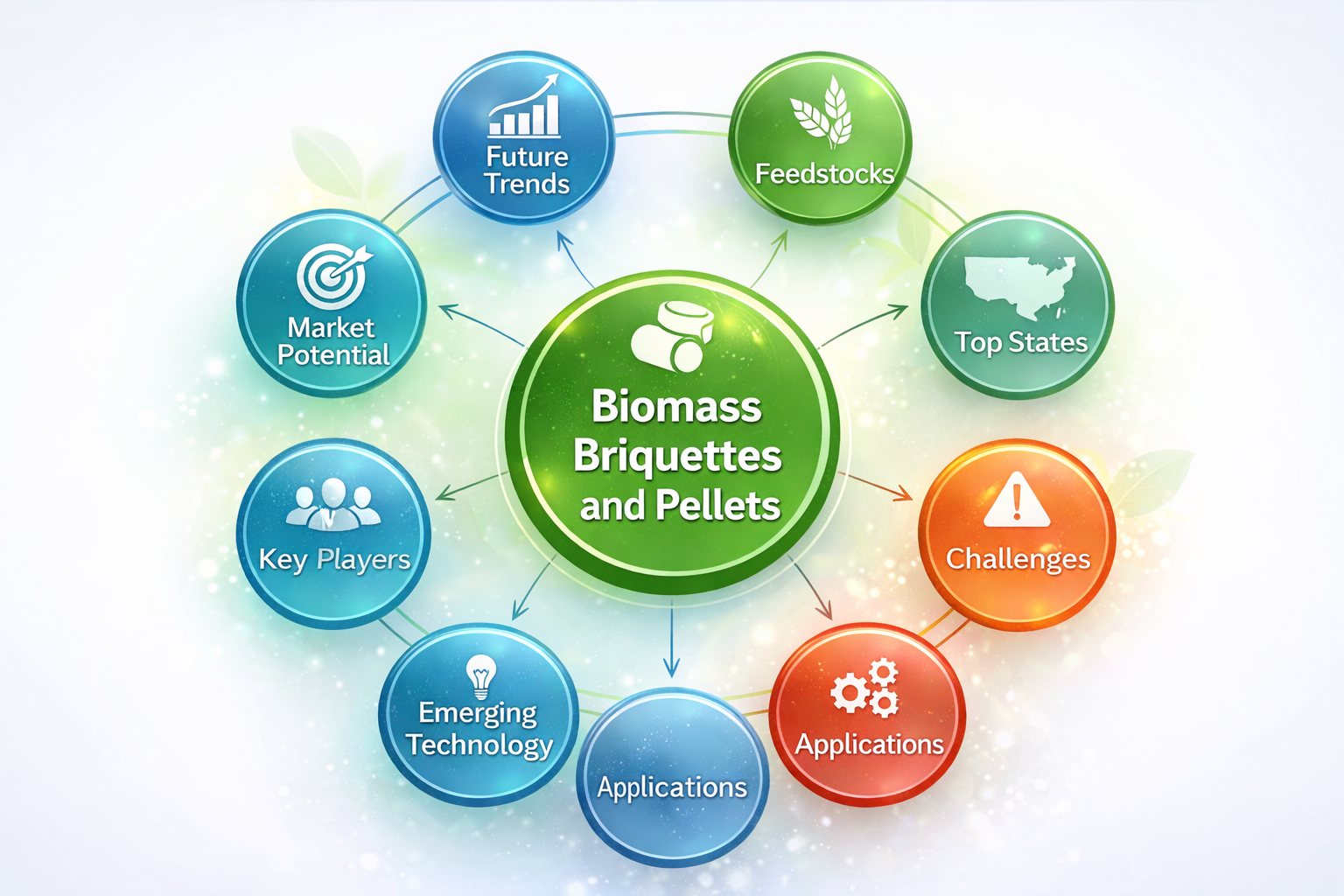
In the landscape of renewable energy, biomass briquettes and pellets serve as pivotal sustainable fuel alternatives. Both are derived from organic materials such as wood, agricultural residues, and industrial waste. However, they differ significantly in physical characteristics, production intensity, and target applications.
While briquettes are typically larger and less dense for industrial use, pellets offer high uniformity and density for specialized residential and small-scale power generation. Driven by government subsidies and a rising need for coal alternatives, the Indian market is poised for exponential growth.
| Category | Biomass Briquettes | Biomass Pellets |
|---|---|---|
| Physical Characteristics |
• Size: 60–90 mm diameter • Density: 500–700 kg/m³ • Moisture: 10–15% • Calorific Value: ~4000–4800 kcal/kg |
• Size: 6–8 mm diameter • Density: 650–1300 kg/m³ • Moisture: Below 10% • Calorific Value: ~4500–5000 kcal/kg |
| Production Intensity |
• Energy Req: 50–60 kWh/ton • Process: Shredding, drying, compression • Binder: Rarely necessary |
• Energy Req: 80–120 kWh/ton • Process: Fine grinding, drying, extrusion • Binder: Often required for integrity |
| Feedstock & Ash |
• Raw Material: Rice husk, sawdust, paper sludge • Ash Content: 6–20% (Higher) |
• Raw Material: Sawdust, wood chips, forest residue • Ash Content: 1–3% (Very Low) |
| Target Sectors | Industrial boilers, brick kilns, community heating systems. | Residential stoves, small power plants, animal bedding. |
| Parameter | International Standard Requirement |
|---|---|
| Moisture Content | Less than 10% |
| Ash Content | Typically less than 1.5% |
| Mechanical Durability | Minimum 97.5% (intact after handling) |
| Calorific Value | Minimum ~4000 kCal/kg |
| Fines Content | Less than 1% (particles < 3.15 mm) |
| Category | Company Examples | Strategic Description | Primary Focus & Products |
|---|---|---|---|
| Producers (Raw Material Suppliers) | Greenware Revolution Pvt. Ltd. | Manufactures eco-friendly packaging using starch-based bioplastics. | Sustainable food service and retail packaging. |
| MESCO Industries Ltd. (Rajasthan) | Sources and processes wood waste from sawmills and forestry operations. | Wood waste resource management. | |
| Nepra Umwelthechnik Pvt. Ltd. (Maharashtra) | Supplies diverse feedstocks including rice husk, groundnut shells, and bagasse. | Pre-processing of diverse biomass materials. | |
| Green Nest (Uttar Pradesh) | Aggregates agricultural residues like wheat straw and corn cobs via farmer networks. | Aggregator model connecting farmers to the biofuel industry. | |
| Manufacturers (Briquette & Pellet Producers) | UCOE Technologies Pvt. Ltd. (Gujarat) | Produces bio-briquettes and pellets using agricultural and industrial residues. | Diversified portfolio for domestic and industrial uses. |
| Akshay Urja Pvt. Ltd. (Maharashtra) | Specializes in high-quality wood pellets for industrial boilers and power plants. | Large-scale industrial biofuel solutions. | |
| Pavan Bio Energy Pvt. Ltd. (Karnataka) | Customizes bio-briquettes and pellets from agricultural residues. | Client-centric customization. | |
| Green Energy Biofuels Pvt. Ltd. | Specializes in high-density biomass fuels from diverse feedstocks. | Supply of high-density biomass solid fuels. | |
| Technology Solution Providers | Pellet Mill India Pvt. Ltd. (Tamil Nadu) | Offers machinery for briquette and pellet making across different capacities. | Manufacturing and supply of densification machinery. |
| Biomass Research Center (BRC) (Assam) | Researches and optimizes conversion technologies for efficient production. | R&D in biomass conversion technologies. |
| Category | Examples & Regions | Strategic Technical Outlook | Core Advantages | Technical & Logistical Challenges |
|---|---|---|---|---|
| Processed Waste |
• Sawdust/Wood Chips (HP, J&K, North-East) • Leftover Wood Pellets • Bagasse |
Generated as byproducts in forestry and sawmills. Rejected pellets can be recycled into high-quality briquette production. | High calorific value for efficient burning; renewable with proper management. | Limited availability vs. ag-residue; higher transport costs from mountainous regions; requires sawmill collaboration. |
| Dedicated Energy Crops (Emerging) |
• Napier Grass • Miscanthus |
Specifically cultivated for biofuel. Government initiatives are increasingly encouraging energy crop plantation for year-round supply. | Sustainable source with consistent quality and potential for multi-harvest cycles. | Requires dedicated land (CAPEX impact); not yet widely cultivated in India; requires long-term planning. |
| Category | Feedstock Examples | Strategic Potential | Core Benefits | Technical & Logistical Challenges |
|---|---|---|---|---|
| Agricultural Byproducts | Crop Stalks/Leaves (Corn, Sorghum, Pulses), Fruit & Veg Waste. | Abundant resources available post-harvest or after spoilage. | Reduces environmental impact; diversifies the feedstock base. | Requires research on densification; moisture management is critical. |
| Sugar Processing Waste | Press Mud | Sugarcane byproducts convertible into high-energy briquettes. | Cost-effective; reduces industrial waste from mills. | Difficult moisture management; requires consistent quality control. |
| Forest Residues | Logging Residues (Branches, Twigs), Forest Thinning (Deadwood). | Utilizing leftovers from forest management and logging. | Promotes forest health; renewable and highly sustainable. | Efficient collection and transportation logistics are costly. |
| Invasive Plant Species | Prosopis Juliflora (Mesquite), Lantana Camara, Bamboo. | Fast-growing invasive plants transformed into valuable biofuel. | Controls invasive growth; creates resource from a nuisance. | Optimal harvesting and processing methods still under research. |
| Municipal Solid Waste (Organic) | Organic Fraction of MSW (Food Waste). | Organic MSW diverted from landfills into fuel production. | Promotes urban waste management; supports circular economy. | Requires strict source separation and specialized pre-processing. |
Ensuring consistent quality and supply chains for raw materials remains one of the most critical challenges in India. Despite high industry competition, addressing logistical barriers in feedstock collection is a priority for market leadership.
| Stage | Challenges | Strategic Technical Description |
|---|---|---|
| Feedstock Availability & Management | Seasonal Variations | Fluctuations in availability based on harvest cycles disrupt production and cause high price volatility. |
| Sustainable Sourcing | Implementing eco-friendly harvesting to prevent resource depletion. | |
| Competition for Land | Balancing land use between food security and energy crops. | |
| Production & Processing | High Initial Investment | Significant upfront CAPEX for setting up high-capacity densification facilities. |
| Technology Limitations | Limited accessibility to advanced processes like Torrefaction or HTC (Hydrothermal Carbonization). | |
| Skilled Workforce Gap | Lack of specialized personnel to operate and maintain high-precision pelletizing equipment. | |
| Market & Distribution | Price Competitiveness | Intense competition from cheaper, low-grade traditional fuels like firewood and raw coal. |
| Limited Awareness | Low public and industrial awareness regarding the long-term ROI of bio-solid fuels. | |
| Inefficient Logistics | Development of robust, cost-effective distribution networks, especially in fragmented rural areas. | |
| Challenges by End-Use | Domestic Cooking | Ensuring affordability for low-income households and driving behavioral change towards cleaner methods. |
| Industrial Applications | High retrofitting costs for existing boilers and difficulty in securing long-term, fixed-price supply contracts. | |
| Power Generation | Establishing logistics for massive feedstock volumes and integrating biomass into existing grid infrastructure. |
EVS (ENERGIA VERDE SOLUTIONS)
Call: +91 95021 07642
Email: sp@energyvss.com | Evs@energyvss.com
Favorable government policies aim to address critical barriers like feedstock availability and cost-effectiveness. Regulations to expand production capacity are strictly aligned with India's commitments to reducing greenhouse gas emissions and achieving renewable energy targets.
| Policy Focus Area | Specific Policy/Scheme | Strategic Technical Description | Target Beneficiary |
|---|---|---|---|
| Demand-Side Incentives (Market Adoption) | Pradhan Mantri Ujjwala Yojana (PMUY) | Subsidies for clean cookstoves designed to utilize bio-based briquettes and pellets efficiently. | Low-income rural households |
| National Biomass Mission | Promotes diversified biomass applications to indirectly boost solid biofuel demand. | Industries and households | |
| NTPC Co-firing Guidelines | Mandating biomass-coal blending in power plants to promote sustainable feedstock utilization. | Power plants, biofuel producers | |
| Supply-Side Incentives (Production Support) | National Mission on Biogas (NHB) | Financial assistance for setting up production units to reduce initial CAPEX burden. | Biofuel producers |
| Subsidies for Machinery | Grants for acquiring advanced processing units like Torrefaction systems. | Biofuel producers | |
| Tax Benefits | Tax breaks and customs duty exemptions for importing specialized densification machinery. | Biofuel producers | |
| Frameworks & Regulations (Quality/Sustainability) | Standards and Certification | Establishing quality benchmarks to ensure product consistency and build consumer trust. | Producers, consumers |
| Sustainable Sourcing Guidelines | Promoting eco-friendly harvesting to ensure long-term sector viability. | Producers, suppliers | |
| Biomass Procurement Policies | Encouraging public institution procurement to create a guaranteed "off-take" market. | Biofuel producers, gov agencies |
| Business Model | Strategic Description | Core Activities | Target Market | Critical Success Factors |
|---|---|---|---|---|
| Integrated Producer-Retailer | A single entity managing the entire value chain, from procurement to retail distribution. | Feedstock sourcing, production (densification), branding, and retail sales. | Rural households, small-scale industries. | Strong value chain control, efficient logistics, and effective branding. |
| Feedstock Supplier | Focuses on collecting, pre-processing, and supplying biomass to large-scale producers. | Sourcing ag-residues/energy crops, drying, size reduction, and logistics. | Briquette and pellet manufacturers. | Reliable high-quality supply, efficient transport network, and competitive pricing. |
| Contract Manufacturing | Operates production facilities to manufacture solid fuels based on specific client contracts. | White-label production, quality assurance, and delivery to client hubs. | Biofuel distributors, power plants, industrial consumers. | Scalable capacity, manufacturing flexibility, and low production costs. |
| Technology Provider | Develops and sells advanced processing hardware (e.g., torrefaction units) and provides maintenance. | R&D of new tech, manufacturing of equipment, installation, and after-sales support. | Established producers, new market entrants. | Technological innovation, strong technical service network, and pricing. |
| Category | Strategic Technical Description | Industry Leaders & Examples |
|---|---|---|
| Captive Power Generation | Setting up in-house biomass power plants utilizing solid biofuels to gain greater control over thermal energy costs and environmental footprints. | ITC Limited, Mahindra Group, Dalmia Cement, Godrej Industries, Triveni Turbine. |
| Waste-to-Wealth Initiatives | Converting internal byproduct streams (bagasse, straw, wood chips) into high-density pellets for sustainable waste valorization. | Sugar Mills (Bajaj Hindusthan), Paper Mills (ITC Bhadrachalam), Agro-Processing (KRBL), Distilleries (Mohan Meakin). |
| Backward Integration | Strategically integrating backward into the production sector to secure a reliable source of densified feedstock and minimize volatile procurement costs. | Century Pulp and Paper, Seshasayee Paper and Boards, Andhra Paper Mills, JK Paper Limited. |
| Technology Partnerships | Collaborating with global and local providers to implement advanced processing like Torrefaction for superior bio-fuel properties. | Aditya Birla with NEXT Renewable, Mahindra with Thermax, IOC with IGL Green Gas, Godrej with EnviServe. |
| Market Expansion & Exports | Exploring export opportunities to Asian and African markets with surging demand for certified renewable solid fuels. | UCO Bioenergy, Emami Biofuels, Green Agro Fuels, Thermax Energy Solutions, Sangam Renewables. |
The biomass briquettes and pellets market in India represents a burgeoning sector with significant potential to transform the country’s energy landscape. By leveraging abundant agricultural residues, forestry waste, and innovative feedstock options like invasive plant species and municipal solid waste (MSW), India can effectively address pressing environmental and energy challenges.
The sector's growth is underpinned by strong market drivers such as the increasing demand for clean cooking solutions, government initiatives supporting biofuel adoption, and the rising availability of biomass feedstock. Furthermore, advancements in production technologies and the development of new product formulations are expected to enhance the competitiveness and industrial appeal of bio-solid fuels.
The growth trajectory of the Indian briquettes & pellets market underscores its role as a key driver in the nation's renewable energy sector. With sustained government backing and technological evolution, this industry is set to play a pivotal role in India's sustainable and energy-secure future.