The Indian Bioplastics market is emerging as a key player in the global shift toward sustainable materials, driven by environmental concerns and policy support.Bioplastics production capacity in India is set to expand rapidly, positioning the country as a significant contributor to the bioeconomy.
This detailed report explores the promising potential of bioplastics and biopolymers as sustainable alternatives to traditional plastics. Derived from renewable biomass sources, these materials offer significant environmental benefits and diverse applications. The report examines market potential, key players, production processes, emerging technologies, end-use applications, challenges, and strategic initiatives within the Indian bioplastics and biopolymers sector.
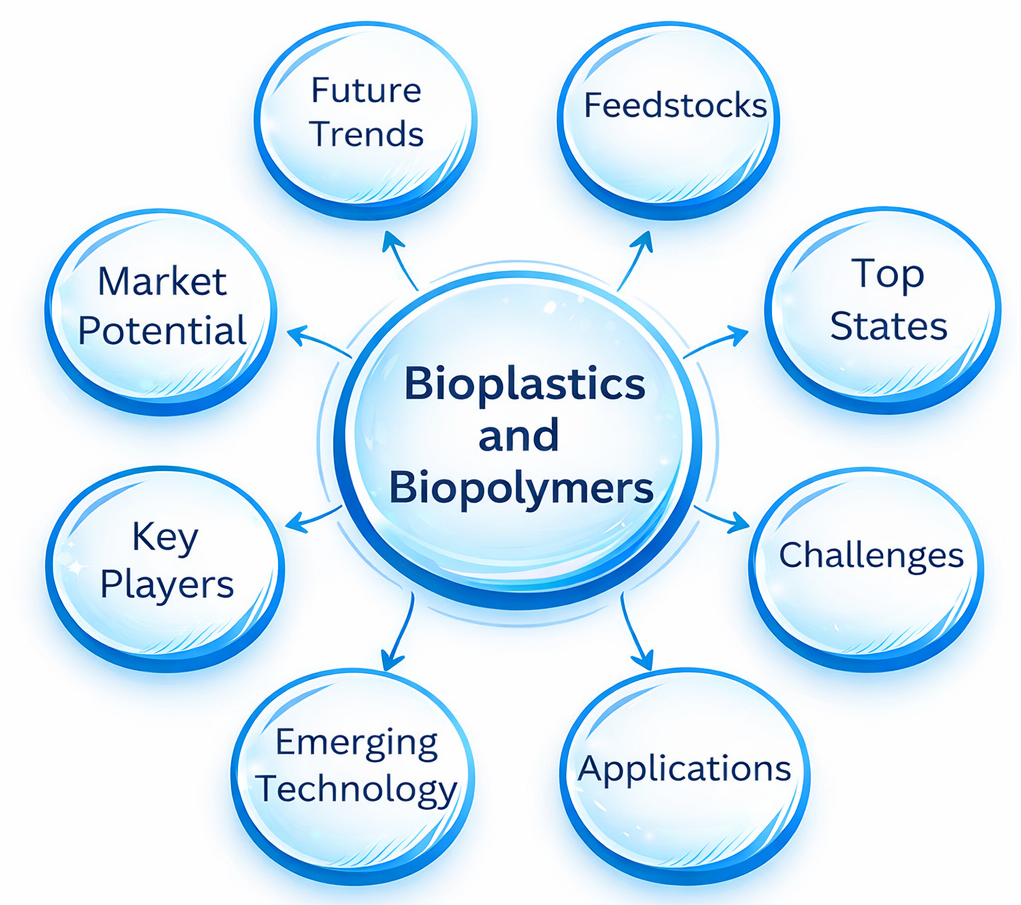
Bioplastics are a specialized category of plastic derived from renewable biomass sources, such as vegetable fats and oils, corn starch, straw, woodchips, and food waste. Biopolymers, conversely, are polymers produced naturally by living organisms. These biopolymers serve as the essential building blocks used in a variety of industrial applications, including the advanced production of bioplastics.
Bioplastics and biopolymers represent a transformative advancement in materials science, offering a high-performance, sustainable, and environmentally friendly alternative to traditional petroleum-based plastics. This sector provides a fundamentally circular energy and material framework, actively reducing plastic pollution and championing the global transition toward renewable and biodegradable resources.
| Category | Bioplastics | Biopolymers |
|---|---|---|
| Characteristics | Size: Small granules (pellets) typically 3-5 mm in diameter | Size: Large molecules, high molecular weight |
| Density: ~1.2 g/cm³ for PLA, similar to PET (1.38 g/cm³) | Density: Varies; e.g., cellulose (~1.5 g/cm³) | |
| Mechanical Properties: Tensile strength ~50-70 MPa for PLA | Mechanical Properties: Tensile strength up to 80 MPa for cellulose | |
| Degradability: PLA biodegrades in industrial composting facilities in 6-12 months | Degradability: Starch-based biopolymers degrade in soil within months | |
| Appearance: Clear or opaque, can be colored or transparent | Appearance: Typically opaque, variable textures | |
| Production Process | Source: Renewable resources like corn starch, sugarcane | Source: Natural polymers from plants (cellulose, starch) and animals (chitosan, gelatin) |
| Method: Fermentation (to produce lactic acid for PLA), polymerization, extrusion | Method: Extraction from natural sources, chemical/enzymatic modification | |
| Energy Use: Lower energy consumption; PLA production uses ~50% less fossil fuel energy than conventional plastics | Energy Use: Variable; cellulose extraction can be energy-intensive | |
| Induced Sector | Packaging industry: PLA for food containers, bottles; PHA for biodegradable bags | Medical field: Chitosan for wound dressings, tissue scaffolding |
| Agriculture: PLA for mulch films, plant pots | Food industry: Starch-based films for edible coatings, packaging | |
| Consumer goods: PLA for disposable cutlery, electronics casings | Industrial applications: Cellulose derivatives for adhesives, lubricants | |
| Prices | Bioplastics: PLA costs ~₹205.12 per kg; PHA costs ~₹451.27 per kg | Biopolymers: Cellulose acetate ~₹369.22 per kg; chitosan ~₹2871.75 per kg |
| Factors: Prices influenced by feedstock costs, economies of scale | Factors: Prices dependent on raw material availability, production complexity |
Talk to ENERGIA VERDE SOLUTION (EVS)
Call: +91 95021 07642
Email: sp@energyvss.com | Evs@energyvss.com
| Category | Company / Example | Role in the Sector |
|---|---|---|
| Bioplastics Producers (Feedstock Suppliers) | Arihant Biotech Ltd. | Cornstarch and bio-based polymers |
| Cargill India Pvt. Ltd. | Starches and industrial starches | |
| ITC Ltd. | Exploring agricultural waste like bagasse for bioplastics | |
| Bioplastic & Bio-based Product Manufacturers | Ecoware | PLA and bio-compostable tableware, cutlery, packaging |
| Biopac India | PLA and biodegradable cups, plates, trays, containers | |
| Shalimar Biofilms | Biodegradable and compostable bags, films, pouches (PLA, bio-based PE) | |
| Aarav Enviro | Biodegradable and compostable bags, cutlery, plates (PLA, bio-based materials) | |
| Zephyr Bioplastics | PLA and bio-based PET bottles, films, sheets | |
| Technology Solution Providers | Thermax Ltd. | Design and engineering of bioplastic manufacturing plants |
| TÜV India Pvt. Ltd. | Biodegradation testing and certification services | |
| Central Institute of Plastics Engineering and Technology (CIPET) | Research and development in bioplastics and biocomposites |
EVS (ENERGIA VERDE SOLUTIONS)
Call: +91 95021 07642
Email: sp@energyvss.com | Evs@energyvss.com
| Feedstock | Description | Availability in India | Region with Highest Availability (Globally) |
|---|---|---|---|
| Starch-based | Derived from crops like corn, tapioca, and potato. | Widely available throughout India, with major production in states like Karnataka, Maharashtra, and Andhra Pradesh. | North America, Europe |
| Sugarcane bagasse | The fibrous residue left after sugarcane juice extraction. | Abundant in sugar-producing states like Maharashtra, Uttar Pradesh, Karnataka, and Tamil Nadu. | Brazil |
| Cellulose | Found in plant cell walls and can be sourced from agricultural waste (straw, bagasse) or dedicated energy crops (miscanthus, switchgrass). | Limited availability from dedicated energy crops, but the potential for utilizing agricultural waste is high. | North America, Europe |
| Non-edible vegetable oils | Extracted from plants like jatropha, algae, or pongamia. | Potential for future production, but currently limited availability due to challenges in cultivation and processing. | Southeast Asia, South America |
| Rank | State | Rationale |
|---|---|---|
| 1 | Maharashtra | * Strong industrial base and existing plastics industry. * Availability of feedstock like sugarcane bagasse from major sugar-producing regions. * Relatively developed infrastructure and access to markets. |
| 2 | Karnataka | * Presence of agricultural universities and research institutions fostering innovation. * Availability of starch-based feedstocks like corn and tapioca. * Growing focus on sustainability and environmental consciousness. |
| 3 | Tamil Nadu | * Established biofuel and biorefinery projects offering potential synergies. * Growing plastics manufacturing sector and skilled workforce. * Government initiatives promoting bioplastics development. |
| 4 | Uttar Pradesh | * Abundant sugarcane resources for potential bagasse utilization. * Large consumer base offering significant market potential. * Growing focus on waste management, potentially creating feedstock opportunities. |
| 5 | Gujarat | * Strong chemical industry presence with potential partnerships and expertise. * Port facilities aiding import/export of feedstock or finished products. * Supportive government policies promoting bio-based industries. |
| 6 | Andhra Pradesh | * Focus on developing bio-industrial parks creating a supportive ecosystem. * Availability of starch-based feedstocks and potential for agricultural waste utilization. * Government initiatives promoting renewable energy and sustainable practices. |
| 7 | Haryana | * Presence of agricultural research institutions and development programs. * Proximity to major northern Indian markets for efficient distribution. * Growing awareness of environmental issues and potential consumer demand. |
| 8 | Punjab | * Strong agricultural base with potential for dedicated energy crop cultivation (subject to feasibility studies). * Focus on agricultural diversification and exploring alternative income sources for farmers. * Government initiatives promoting sustainable agriculture practices. |
| 9 | Madhya Pradesh | * Abundant agricultural land for potential feedstock production (subject to responsible sourcing). * Growing focus on rural development and creating new economic opportunities. * Government initiatives promoting innovation and entrepreneurship in rural areas. |
| 10 | Odisha | * Emerging biofuel sector with potential for feedstock integration. * Focus on developing industrial corridors and infrastructure. * Government initiatives promoting investments in clean technologies. |
The bioplastics sector in India is actively exploring alternative feedstocks to diversify options and potentially enhance sustainability. Here’s a table outlining some emerging and under-research feedstock options:
| Feedstock | Description | Availability in India | Potential Advantages | Challenges |
|---|---|---|---|---|
| Agricultural Waste | Straws from rice, wheat, and other cereals; bagasse after sugarcane juice extraction; fruit and vegetable peels and cores. | Large potential across India, varying seasonally with agricultural cycles. | Abundant, low-cost, and reduces reliance on virgin crops. | Requires efficient collection, pre-treatment infrastructure, and ensuring responsible waste management practices. |
| Algae | Microscopic aquatic organisms cultivated in controlled environments. | Limited commercial production currently, but potential for expansion in coastal or arid regions. | Renewable, fast-growing, and can utilize wastewater or saline water for cultivation. | Requires significant research and development to optimize cultivation methods and cost-effectiveness for large-scale production. |
| Jatropha Oil | Oil extracted from the seeds of the Jatropha curcas plant. | Potential for cultivation on marginal lands not suitable for food crops, particularly in drier regions. | Drought-tolerant, potential for wasteland utilization, and offers additional income for farmers. | Toxicity concerns require careful processing and responsible waste management. Cultivation success depends on suitable land, climate, and agronomic practices. |
| Microorganisms | Bacteria or fungi capable of producing bioplastics through fermentation processes. | Availability depends on specific microbial strains and fermentation technology development. | Can utilize various feedstocks (sugars, waste streams) and offer the potential for high-value bioplastics with unique properties. | Requires significant research on strain development, optimizing fermentation processes, and ensuring cost-competitiveness. |
| Wastewater Treatment Sludge | Organic material is removed during wastewater treatment processes. | Abundantly available in urban and industrial areas. | Offers waste valorization solution and potential for circular economy approach. | Requires pre-treatment to remove contaminants and ensure product safety. The technical feasibility of bioplastic production from sludge needs further research. |
Advanced Bioplastics production technology is being developed to enhance scalability and cost-effectiveness, making bioplastics a viable alternative to conventional plastics. Bioplastics technology in India is focusing on integrating local feedstock sources to minimize production costs and improve supply chain efficiency.
| Application | Description | Advantages | Future Directions | Example |
|---|---|---|---|---|
| Compostable Bags | Grocery shopping bags, trash disposal bags | Biodegradable, reduces plastic waste, promotes responsible waste management | Improved biodegradability rates, wider availability of composting infrastructure | TIPA (Israel): Produces compostable bags for grocery shopping and trash disposal with high-speed biodegradability. |
| Food Packaging Trays & Films | Trays for fruits, vegetables, and other food items; films for wrapping food | Similar functionality to conventional plastics, compostable or lower environmental footprint | Enhanced functionality (e.g., barrier properties), improved aesthetics and printability | NatureWorks (USA): Provides bioplastic trays and films made from Ingeo PLA, optimized for food freshness. |
| Beverage Bottles | Bottles for water, beverages, and other liquids | Bio-based alternative to PET bottles, potentially lower environmental footprint | Improved recycling infrastructure and consumer education for proper disposal | Coca-Cola: Their PlantBottle uses bio-based PET, offering a lower environmental footprint compared to standard plastic. |
| Biodegradable Mulch Films | Suppress weeds, retain moisture, and improve crop yields in agriculture | Biodegradable, eliminates the need for separate removal, reduces plastic waste in agriculture | Enhanced performance (e.g., weed suppression, water retention), wider adoption in diverse agricultural practices | BASF's ecovio®: Produces biodegradable mulch films that eliminate the need for mechanical removal after the growing season. |
| Disposable Cutlery & Plates | Utensils and plates for picnics, catering events, and everyday use | Sustainable alternative to conventional plastics, reduces waste generation in single-use applications | Improved functionality (e.g., heat resistance, durability), a wider variety of designs and options | Bio Futura: Offers a wide range of disposable tableware made from renewable bioplastics for the catering industry. |
| Bio-based Textiles | Clothing, footwear, and other textile products | Sustainable clothing options, lower environmental impact compared to conventional synthetic fibers | Improved comfort, durability, and performance of bio-based fabrics; wider adoption by major clothing brands | Adidas: Uses bio-based materials like recycled biopolymer in their textile products to offer sustainable footwear and apparel. |
| Biomedical Implants & Scaffolds | Temporary support for healing in medical procedures | Biodegradable, eliminates the need for further surgery for removal | Development of bioplastics with tailored properties for specific medical applications; personalized medicine advancements | Bioretec (Finland): Develops biodegradable implants and scaffolds that eliminate the need for secondary surgeries once healing is complete. |
| 3D Printing Filaments | Create 3D-printed objects from sustainable materials | Sustainable alternatives to conventional filaments; open doors for various applications | Improved printability; a wider range of bio-based filaments with specific properties for diverse 3D printing applications | Colorfabb (Netherlands): Offers specialized PLA/PHA filaments, providing a sustainable and high-performance alternative to petroleum-based 3D printing materials. |
| Building & Construction Materials | Insulation panels, furniture components, and other construction applications | Sustainable construction practices; reduced reliance on traditional materials | Development of bio-based composites with enhanced mechanical properties and fire resistance; wider adoption in green building projects | Green Building Solutions: Develops insulation panels and furniture components from bioplastics to promote carbon-neutral construction. |
| Sector | Benefits | Description |
|---|---|---|
| Agriculture | * Reduced plastic waste * Improved soil health * Sustainable crop management | Biodegradable mulch films and seedling trays minimize plastic pollution. Some bioplastics can potentially enhance soil health through decomposition. Bio-based fertilizers and pest control solutions offer eco-friendly alternatives. |
| Packaging Industry | * Sustainable packaging solutions * Enhanced brand image * Compliance with regulations | Bioplastics offer a more responsible and eco-friendly alternative to conventional plastics. Companies adopting bioplastics can demonstrate their commitment to sustainability, potentially attracting environmentally conscious consumers. As regulations on plastic usage become stricter, bioplastics can help packaging companies comply with environmental norms. |
| Waste Management | * Reduced landfill waste * Development of composting infrastructure * Job creation | Biodegradable bioplastics can divert waste from landfills, reducing pressure on existing infrastructure. Increased use of bioplastics can drive the development of efficient composting facilities, creating new waste management solutions. The composting and recycling of bioplastics can create new employment opportunities in the waste management sector. |
| Consumer Goods Manufacturing | * Sustainable product development * Meeting consumer demand * Differentiation in the market | Bioplastics enable manufacturers to create eco-friendly consumer goods like clothing, toys, and disposable items. Consumers increasingly seek sustainable products, and bioplastics can help manufacturers cater to this growing demand. Utilizing bioplastics can give manufacturers a competitive edge by offering environmentally conscious products. |
| Government and Public Sector | * Achieves environmental sustainability goals * Promotes a circular economy * Creation of green jobs | Bioplastics can help India achieve its environmental sustainability goals by reducing plastic pollution and promoting a circular economy. The bioplastics industry has the potential to create new green jobs in manufacturing, research, and waste management. A thriving bioplastics sector can contribute to the development of a robust bioeconomy in India. |
| Sector | Benefits | Description | Examples |
|---|---|---|---|
| Healthcare and Pharmaceuticals | * Sustainable medical products * Reduced environmental footprint * Improved patient care | Biodegradable implants and scaffolds can eliminate the need for additional surgery for removal. Bio-based drug delivery systems can offer controlled release and potentially reduce side effects. Biodegradable wound dressings can promote healing and minimize waste generation. | Bioretec: Develops biodegradable implants and scaffolds to eliminate follow-up surgeries. Location: Tampere, Finland. |
| Ecotourism and Hospitality | * Sustainable tourism practices * Reduced plastic waste generation * Enhanced brand image | Biodegradable cutlery, plates, and amenity kits can minimize plastic waste in these sectors. Bio-based furniture and building materials can contribute to eco-friendly infrastructure development. | ITC Hotels: Implements biodegradable cutlery, plates, and amenity kits to align with sustainable tourism practices. Location: Gurgaon, Haryana, India. |
| Logistics and Transportation | * Lighter and potentially more fuel-efficient vehicles * Reduced reliance on fossil-based materials * Exploration of bio-based fuels | Biocomposites can be used in interior panels, dashboards, and even structural components of vehicles in the future, subject to further research and development. | Tata Motors: Explores the use of biocomposites in vehicle components such as interior panels and dashboards to reduce vehicle weight. Location: Mumbai, Maharashtra. |
| Education and Research | * Educational tools for sustainability * Practical learning opportunities * Fostering innovation in bioplastics | Bio-based models can be used to demonstrate various scientific concepts related to materials science, environmental sustainability, and biodegradation. Research institutions can utilize bioplastics for prototyping. | IIT Madras: Uses bio-based models and educational tools to promote sustainability awareness and employs bioplastics for prototyping new technologies. Location: Chennai, Tamil Nadu. |
One of the key challenges of Bioplastics is maintaining cost competitiveness with traditional plastics, especially in markets where price sensitivity is high. Despite challenges, the environmental benefits of Bioplastics, such as reduced carbon footprint and biodegradability, make them an attractive solution for industries aiming to achieve sustainability goals.
| Driver/Opportunity | Description | Example |
|---|---|---|
| Environmental Concerns & Regulations | Growing public concern about plastic pollution and stricter regulations on single-use plastics. | Filling the market gap created by bans on single-use plastics with bio-based alternatives. |
| Feedstock Availability | Abundant and diverse feedstock options like agricultural waste and non-food crops. | Utilizing agricultural waste like rice straw or sugarcane bagasse for bioplastic production, addressing waste management and creating income for farmers. |
| Government Initiatives & Support | Supportive policies like the "Biofuels Policy" and potential for further streamlining. | Streamlining the "Biofuels Policy" to incentivize bioplastic production facilities and research & development. |
| Technological Advancements | Ongoing research and development in bio-based alternatives and functional polymers. | Developing bio-based alternatives to PET for sustainable packaging solutions in the food and beverage industry. |
| Consumer Demand | Growing demand for sustainable products. | Collaborating with e-commerce platforms and retailers to promote bio-based products and educate consumers. |
| Job Creation & Economic Growth | Potential for job creation in manufacturing and waste management. | Setting up bioplastic manufacturing facilities in rural areas to create job opportunities and contribute to rural development. |
| New Applications | Exploring bioplastics in diverse sectors beyond packaging. | Utilizing agricultural waste like rice straw or sugarcane bagasse for bioplastic production, addressing waste management, and creating income for farmers. |
| Circular Economy | Efficient composting infrastructure and responsible end-of-life management practices. | Developing composting infrastructure and promoting consumer education about proper disposal of bioplastics for a circular economy approach. |
Investment in the Bioplastics sector is gaining momentum, with stakeholders focusing on scaling operations to meet the anticipated rise in demand. The Bioplastics market growth presents substantial profits and returns for companies that can innovate and meet the evolving requirements of consumers.
| Business Model | Description | Value Proposition | Revenue Generation | Example |
|---|---|---|---|---|
| Bioplastic Feedstock Production | Cultivating or sourcing agricultural feedstock for bioplastic production. | Provides a reliable and sustainable source of raw material. | Selling the feedstock to bioplastic producers or processors. | Companies specializing in cultivating jatropha or miscanthus. |
| Bioplastic & Bio-based Product Manufacturing | Converting various feedstocks into bioplastics through different processes. | Offers bioplastics in various forms for diverse applications. | Selling bioplastics to converters, packaging companies, or manufacturers. | Ecoware (India), Biotrel (operating in India). |
| Bioplastic Conversion | Purchasing bioplastic granules/pellets and converting them into finished products. | Offers customized bioplastic products tailored to specific needs. | Selling finished bioplastic products to businesses or consumers. | Companies specializing in converting bioplastics into compostable bags, food packaging films, or biodegradable cutlery. |
| Biocomposite Development | Combining bioplastics with natural fibers or minerals to create novel materials. | Offers bio-based composites with improved properties for various applications. | Selling biocomposites to manufacturers in the automotive, construction, or furniture industries. | InCred Organics (India) |
| Integrated Bioplastics Solutions | Offering a comprehensive solution encompassing the entire bioplastics value chain. | Provides a one-stop shop for bioplastic solutions. | Combination of revenue streams from feedstock sales, bioplastic production, conversion services, and potentially waste management fees. | While uncommon currently, could emerge in the future. |
| Bioplastics Recycling and Composting | Collecting, processing, and recycling specific bioplastics or managing composting facilities. | Contributes to a circular economy by diverting bioplastics from landfills and creating valuable recycled materials. | Charging fees for collection and processing services, or selling recycled bioplastic content. Tipping fees for accepting biodegradable waste and potentially selling compost. | While still nascent, companies specializing in composting or bioplastics recycling could gain traction. |
Recognizing the potential of bioplastics for sustainability and economic growth, Indian industries are taking various strategic initiatives to establish themselves in this sector.
The bioplastics and biopolymers sector in India is experiencing rapid growth, driven by increased environmental awareness and supportive government policies. With a market projected to grow from USD 447.25 million in 2023 to USD 1,809.51 million by 2030, there are significant opportunities for local manufacturers to expand production and reduce reliance on imports. Currently, biodegradable bioplastics like PLA and starch-based products dominate the market, particularly in packaging and disposable items, supported by initiatives like the "Swachh Bharat Abhiyan." However, comprehensive regulations are needed to ensure product quality and responsible sourcing.
The future potential of this sector is immense, with opportunities for diversifying into non-biodegradable bioplastics like bio-based PET and PE. As the Bioplastics production capacity in India increases, the industry is expected to achieve greater economies of scale, reducing costs and expanding market penetration. With consistent investment and supportive policies, the Bioplastics industry in India is poised to become a global leader, offering sustainable solutions across various sectors.
EVS (Energia Verde Solution)
Call: +91 95021 07642
Email: sp@energyvss.com | Evs@energyvss.com