India Sustainable Aviation Fuel: Market Potential, Costs, Companies, Technology
by EVS (Energia Verde Solutions) | March 18, 2026 | Bio Based Pathways, Bio Products, Biofuels, Biomass to Liquid, Industrial Products, Insights
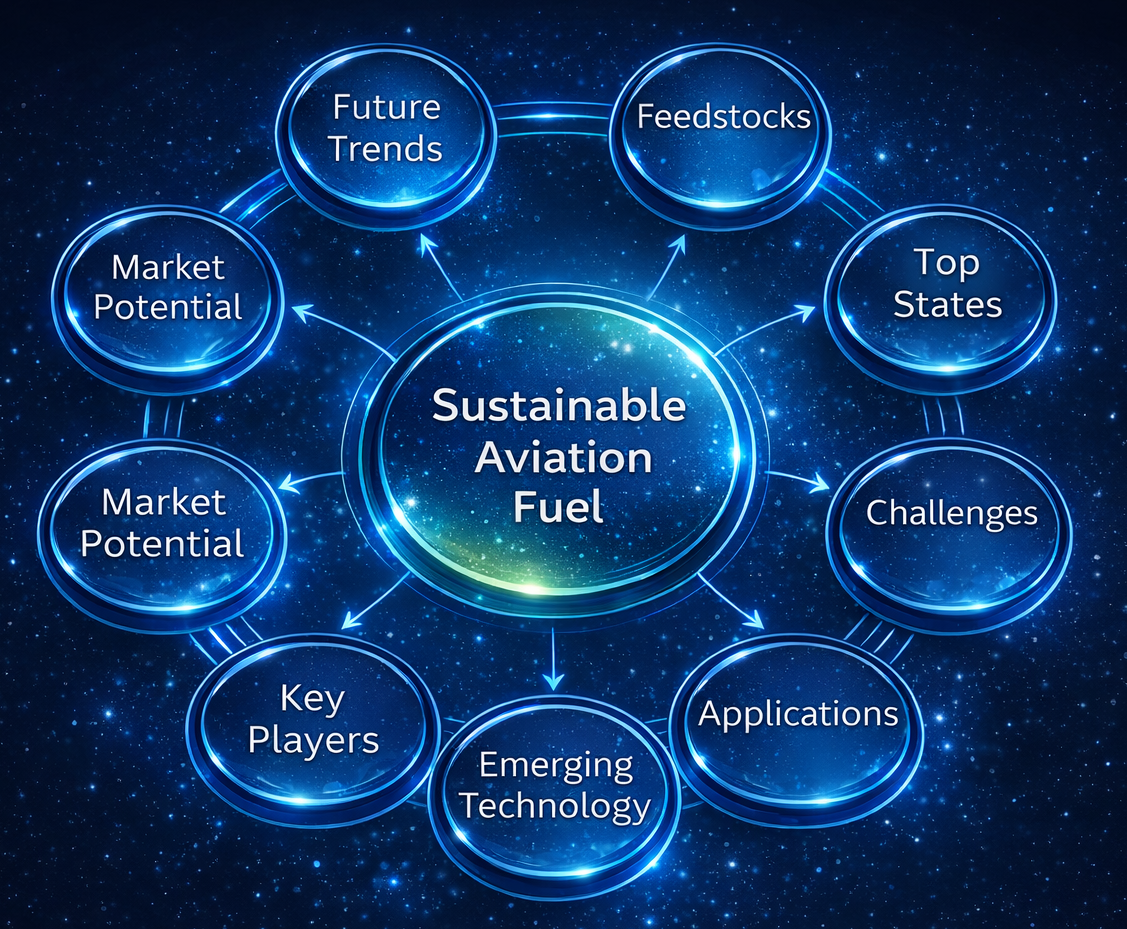
Key Questions Addressed in this Section
- What is the current global market valuation of the Sustainable Aviation Fuel (SAF) industry?
- What is the projected growth trajectory for SAF adoption within the Indian aviation sector by 2030?
- Which technical pathways (HEFA, AtJ, Power-to-Liquid) are most viable for the Indian landscape?
- What are the primary sustainable feedstocks in India capable of meeting SAF production demands?
- How do current Indian government mandates and blending targets influence the SAF market?
- What is the measurable reduction in life-cycle CO2 emissions when utilizing SAF over traditional kerosene?
- Who are the leading corporate players and refineries spearheading SAF production in India?
- What economic and logistical hurdles currently restrict the large-scale deployment of SAF?
- What are the most promising emerging technologies for high-efficiency SAF synthesis?
- How does the cost per gigajoule of SAF compare to traditional Aviation Turbine Fuel (ATF)?
- What recent breakthroughs in catalyst technology have improved SAF conversion rates?
- What is the estimated capital expenditure required for a dedicated SAF production facility?
- What is the long-term potential for India to become a global hub for SAF exports?
- How is the SAF supply chain being integrated with existing airport fueling infrastructure?
- By what specific chemical processes are biofuels upgraded to meet stringent jet fuel standards?
- Which Indian states offer the most favorable logistics for SAF feedstock collection and refining?
The Indian Sustainable Aviation Fuel (SAF) market is emerging as a critical frontier in the global aviation decarbonization effort, driven by urgent net-zero targets and robust policy interventions. SAF production capacity in India is poised for exponential growth, positioning the country as a vital contributor to the sustainable bio-economy.
This detailed report delves into the promising potential of Sustainable Aviation Fuel (SAF) as the primary alternative to fossil-based jet fuels. Derived from renewable feedstocks and waste streams, SAF offers a significant reduction in aviation’s carbon footprint. The report examines market dynamics, technological pathways, feedstock availability, infrastructure challenges, and strategic industry initiatives within the Indian SAF sector.
Table of Content
- 1. Introduction
- 2. Market Potential of SAF
- 3. Key Players & Refineries
- 4. SAF Production Processes (HEFA, AtJ, G+FT)
- 5. Feedstock Options and Availability in India
- 6. Top States for SAF Infrastructure
- 7. Emerging Feedstocks & Waste-to-Fuel
- 8. New Technologies in the SAF Sector
- 9. End-Use Applications & Airport Integration
- 10. Benefiting Airline Sectors
- 11. Key Challenges in the SAF Industry
- 12. Drivers and Opportunities in Sustainable Aviation
- 13. Government Mandates and SAF Policies
- 14. Business Models for SAF Production
- 15. Strategic Initiatives by Indian Industries
- 16. Conclusion
1. Introduction
Sustainable Aviation Fuel (SAF) represents a specialized category of liquid fuels derived from renewable biomass sources, including used cooking oils, agricultural residues, woody biomass, and even captured carbon. Unlike traditional petroleum-based jet fuels, SAF is designed to be a "drop-in" solution, meaning it is chemically similar to conventional kerosene and can be used in existing aircraft engines without modification.
SAF is the most viable medium-term solution for decarbonizing long-haul flights where electric or hydrogen propulsion remains technologically distant. By offering up to an 80% reduction in life-cycle CO2 emissions, this sector provides a fundamentally sustainable energy framework, championing the global transition toward carbon-neutral skies while supporting India’s commitment to international aviation standards like CORSIA.
The Indian sustainable aviation fuel market is poised to revolutionize the aviation sector by providing eco-friendly alternatives to traditional jet fuel. With increasing global emphasis on reducing carbon emissions, sustainable aviation fuel technology in India is emerging as a critical solution.
2. Market Potential
Current Market Potential
- The global market for SAF was valued at approximately USD 1.1 billion in 2023 and is expected to reach USD 16.8 billion by 2030, at an attractive compound annual growth rate (CAGR) of 47.7%.
- While SAF currently only accounts for a small fraction of the overall aviation fuel market (less than 0.1%), its usage is rapidly increasing. In 2022, global SAF production reached an estimated 300,000 tonnes, with significant growth expected in the coming years.
Future Market Potential
- The future market potential for SAF is significant, with estimates suggesting it could account for up to 50% of the global aviation fuel market by 2050. This will require a massive increase in production capacity, driven by environmental mandates and economic benefits.
Key Factors Influencing SAF Market Potential
- The Cost of Production: As processes become more efficient and economies of scale are achieved, the cost of SAF is expected to decrease, making it more competitive with conventional jet fuel.
- Government Policies and Incentives: Supportive frameworks, such as tax breaks, carbon credits, and subsidies, are crucial in stimulating SAF development and adoption.
- Technological Advancements: Continued R&D in feedstock processing, conversion technologies, and logistics will further improve cost-effectiveness.
- Consumer Demand: Growing awareness of aviation's environmental impact and a willingness to pay a premium for sustainable travel are major demand drivers.
The sustainable aviation fuel market growth in India is driven by increasing demand for greener aviation practices and robust government support. By 2030, the Indian market size is expected to expand significantly, with a projected CAGR that underscores the industry’s rapid development. Investment in domestic SAF production capacity is critical to meeting both domestic and international demand for eco-friendly aviation fuel.
3. Key Players
| Category |
Examples |
Description |
| Producers (Pilot/Demonstration Phase) |
Indian Oil Corporation (IOC) |
Piloting green hydrogen-based SAF production at the Mathura refinery. |
|
Praj Industries |
Developing indigenous technologies for SAF production from various agricultural feedstocks. |
| Raw Material Suppliers (Potential Sources) |
UCO Aggregators, Jatropha Cultivators, Algae Researchers |
Focusing on Used Cooking Oil (UCO), municipal solid waste, and lignocellulosic biomass (crop waste/bagasse). |
| Technology Solution Providers |
IIP, TERI, CSIR-IICT |
Leading research institutes focused on biofuels, bioconversion technologies, and sustainable aviation solutions. |
|
IITs & BARDC |
Conducting R&D on feedstocks and conversion technologies customized for the Indian environment. |
| Government Agencies |
MoPNG |
Responsible for formulating policies and implementing initiatives for SAF promotion in India. |
4. SAF Production Processes
1. Feedstock Selection and Pre-Treatment
- Used Cooking Oil (UCO):
- Pre-treatment: Primarily involves filtration to remove impurities and water. Depending on quality, deacidification or degumming may be necessary.
- Technical details: High triglyceride content makes it suitable for the HEFA process, requiring minimal chemical conversion.
- Biomass (e.g., Jatropha):
- Pre-treatment: Involves crushing, grinding, and potentially pyrolysis (heating without oxygen) to release oils suitable for conversion.
- Technical details: Conditions vary significantly based on the specific biomass feedstock and desired output quality.
- Municipal Solid Waste (Organic Fraction):
- Pre-treatment: Requires advanced technologies like anaerobic digestion to convert the organic fraction into bio-oil.
- Technical details: Efficient waste segregation systems are critical to ensure the quality and sustainability of the derived feedstock.
- Lignocellulosic Biomass (e.g., Sugarcane Bagasse):
- Pre-treatment: Employs mechanical grinding and chemical enzymatic hydrolysis to break down cellulose into fermentable sugars.
- Technical details: Optimizing the pre-treatment is the most crucial factor for the economic viability of this feedstock option.
2. Conversion Pathways
a) Hydroprocessed Esters and Fatty Acids (HEFA)
- Process specifics:
- Esterification: Uses methanol and a solid acid catalyst at approx. 65°C and 1 atm pressure.
- Hydrotreatment: Uses hydrogen at high pressure (70–100 atm) and temperatures (300–400°C) with a nickel catalyst to saturate carbon bonds and remove oxygen.
b) Biomass-to-Liquids (BTL) Pathway
- i) Gasification: Occurs in a gasifier at extreme temperatures (700–1500°C) with limited oxygen to create syngas.
- ii) Fischer-Tropsch (FT) Synthesis: Syngas is passed through a fixed-bed reactor with cobalt or iron catalysts at 220–350°C and 10–30 atm to produce liquid hydrocarbons.
c) Alcohol-to-Jet Fuel Direct Pathway
- i) Alcohol Dehydration:
- Process specifics: Alcohols (e.g., ethanol or butanol) are converted into olefins at 300–450°C using acidic catalysts like zeolites to remove water molecules.
- ii) Oligomerization:
- Process specifics: Olefins are polymerized into longer-chain hydrocarbons at 150–300°C and 1–10 atm, using phosphoric acid on silica or zeolites.
- iii) Hydrogenation and Fractionation:
- Process specifics: Hydrocarbons are saturated with hydrogen at 200–300°C and 10–50 atm using palladium or nickel. The final product is distilled into C8–C16 jet fuel range hydrocarbons.
3. Upgrading and Refining
Refining conditions vary depending on the intermediate product composition. EVS (ENERGIA VERDE SOLUTIONS) focuses on these high-performance technologies:
- Hydrocracking: Employs zeolites at high temperatures and pressures to crack long-chain hydrocarbons into smaller, usable molecules.
- Isomerization: Utilizes acidic catalysts to rearrange carbon chains for improved fuel performance and freezing points.
4. Blending and Certification
- Blending: Typically involves mixing SAF with conventional jet fuel at ratios such as 50/50 or 20/80 (SAF/conventional fuel).
- Certification: Rigorous evaluation against international standards like ASTM D7566 and ICAO Annex 16, ensuring critical properties like flash point, freezing point, and lubricity are met.
5. Feedstock Options and Availability in India
| Feedstock |
Description |
Potential Availability in India |
Advantages |
Disadvantages |
| Used Cooking Oil (UCO) |
Waste vegetable oil collected from restaurants, households, and food processing facilities. |
Widely available across India, especially in urban areas. |
Requires significant water and nutrient inputs, and needs advanced cultivation technologies. |
Requires efficient collection and processing infrastructure. |
| Non-food Oilseed Crops (e.g., Jatropha, Pongamia) |
Plants cultivated specifically for oil production on non-arable land. |
Suitable for wastelands and degraded lands. Relatively drought-resistant (Gujarat, Rajasthan, Andhra Pradesh). |
Relatively drought-resistant. |
Dedicated land required; potential for competition with other land uses. |
| Algae |
Microscopic organisms grown in controlled environments or open ponds. |
Potential across India with suitable water and climate conditions. |
High oil yields and potential for CO2 capture. |
Biodegradable portions of municipal waste are separated through composting or anaerobic digestion. |
| Agricultural Residues (e.g., Sugarcane Bagasse, Rice Straw) |
Leftover materials from agricultural practices. |
Abundantly available in major agricultural regions (Maharashtra, Karnataka, Uttar Pradesh, Punjab). |
Doesn’t require additional land; reduces the burning of agricultural waste. |
Pre-treatment challenges; competes with other uses like composting. |
| Municipal Solid Waste (Organic Fraction) |
Biodegradable portions of municipal waste separated through composting or anaerobic digestion. |
Available in all urban areas with waste management systems. |
Diverts waste from landfills; potential for renewable energy co-production. |
Requires efficient waste segregation and processing infrastructure. |
6. New Technologies in the SAF Sector
| Technology |
Description |
TRL Level |
Advantages |
Disadvantages |
Example |
| Consolidated Bioprocessing (CBP) |
Combines biomass pre-treatment, fermentation, and product separation into a single process. |
3–4 |
Less complex process layout; potentially higher yields and efficiency. |
Requires further development to achieve commercial viability. |
LanzaTech: Converts industrial waste gases into ethanol/chemicals. |
| Electrofuels |
Utilizes renewable electricity and captured CO2 or water to produce synthetic fuels like SAF. |
3–4 |
Utilizes high-moisture feedstocks; potentially reduces pre-treatment needs. |
Requires significant cost reductions in electrolysis and conversion steps. |
Carbon Clean Solutions: Researching CO2 utilization for fuel production. |
| Catalytic Fast Pyrolysis (CFP) |
Converts biomass into bio-oil using a catalyst at high temperatures and short residence times. |
4–5 |
Higher bio-oil yields compared to conventional pyrolysis; integrates with gasification. |
Requires optimization for specific feedstocks and product properties. |
Praj Industries: Developing CFP for bio-oil from agricultural residues. |
| Advanced Hydrothermal Liquefaction (AHL) |
Converts wet biomass (including algae) into bio-crude oil using high temperatures and pressure in water. |
3–4 |
Bypasses need for intermediate conversion steps; utilizes low-quality feedstocks. |
Requires research to address scaling up and wastewater treatment challenges. |
IISc (Indian Institute of Science): Researching AHL for bio-crude from wet biomass. |
7. End-Use Applications of Sustainable Aviation Fuel (SAF)
| Application |
Description |
Benefits |
Current Status |
Example |
| Commercial Passenger Flights |
Powers aircraft for transporting passengers across domestic and international routes. |
Primary decarbonization tool; reduces life-cycle emissions significantly. |
Primary application; used in blends with conventional jet fuel. |
SpiceJet: Conducted India's first biofuel-powered flight. |
| Cargo Flights |
Powers aircraft for transporting goods and heavy air cargo. |
Reduces environmental impact of logistics, crucial for a growing e-commerce sector. |
Early adoption; similar blending considerations as passenger flights. |
FedEx: Implementing SAF in cargo flights to reduce carbon footprint globally. |
| Military Aviation |
Powering military aircraft, subject to meeting high-performance specifications. |
Enhances energy security; reduces reliance on imported fossil fuels. |
Limited exploration; rigorous testing for mission-critical aircraft. |
US Air Force: Actively testing SAF for diverse military platforms. |
| General Aviation (Private Jets) |
Powering smaller aircraft, private jets, and business business aircraft. |
Offers sustainable travel options for high-net-worth individuals and corporate fleets. |
Research and development phase; not yet widely available. |
NetJets: Exploring SAF for its global fleet of private jets. |
8. Key Challenges
- 1. Limited Production and High Cost:
- Current global production capacity is far below the demand, leading to limited availability for airlines.
- Production processes are more complex and expensive compared to conventional fossil-based kerosene.
- Example: World Energy is expanding production capacity in Los Angeles to meet global demand.
- 2. Feedstock Sustainability:
- Ensuring the sustainability of feedstock production is crucial to avoid unintended consequences like deforestation or competition with food crops.
- Balancing diverse feedstock options with strict sustainable sourcing practices remains a complex logistical challenge.
- Example: Neste (Finland) focuses exclusively on waste and residues for their SAF production.
- 3. Policy and Regulatory Framework:
- A clear and supportive framework is required to incentivize investment and encourage airline adoption.
- Carbon pricing and blending mandates are essential tools to make SAF price-competitive with conventional jet fuel.
- Example: ICAO is developing global standards and policies to promote SAF usage in international aviation.
- 4. Technological Advancements:
- Continuous R&D is required to improve existing conversion processes and explore more cost-effective production pathways.
- Scaling up production capacity through infrastructure development is essential to meet skyrocketing future demand.
- Example: The National Renewable Energy Laboratory (NREL) is researching next-gen technologies to improve SAF yields.
- 5. Public Awareness and Support:
- Raising awareness about the decarbonization role of SAF is crucial for fostering market demand and wider industry support.
- Collaboration between government agencies, airlines, and fuel producers is vital for successful deployment.
- Example: ATAG (Air Transport Action Group) promotes SAF benefits through global awareness campaigns.
Key challenges of sustainable aviation fuel include achieving cost competitiveness and establishing a consistent supply chain for raw materials. Despite these hurdles, the environmental benefits—such as reduced GHG emissions and improved air quality—make it a viable long-term solution. Industry players are investing heavily in R&D to overcome these technical and logistical barriers.
- 2. Feedstock Sustainability:
- Ensuring the sustainability of feedstock production is crucial to avoid unintended consequences like deforestation or competition with food crops.
- Balancing diverse feedstock options with strict sustainable sourcing practices remains a complex logistical challenge.
- Example: Neste (Finland) focuses exclusively on waste and residues for their SAF production.
- 3. Policy and Regulatory Framework:
- A clear and supportive framework is required to incentivize investment and encourage airline adoption.
- Carbon pricing and blending mandates are essential tools to make SAF price-competitive with conventional jet fuel.
- Example: ICAO is developing global standards and policies to promote SAF usage in international aviation.
- 4. Technological Advancements:
- Continuous R&D is required to improve existing conversion processes and explore more cost-effective production pathways.
- Scaling up production capacity through infrastructure development is essential to meet skyrocketing future demand.
- Example: The National Renewable Energy Laboratory (NREL) is researching next-gen technologies to improve SAF yields.
- 5. Public Awareness and Support:
- Raising awareness about the decarbonization role of SAF is crucial for fostering market demand and wider industry support.
- Collaboration between government agencies, airlines, and fuel producers is vital for successful deployment.
- Example: ATAG (Air Transport Action Group) promotes SAF benefits through global awareness campaigns.
Key challenges of sustainable aviation fuel include achieving cost competitiveness and establishing a consistent supply chain for raw materials. Despite these hurdles, the environmental benefits—such as reduced GHG emissions and improved air quality—make it a viable long-term solution. Industry players are investing heavily in R&D to overcome these technical and logistical barriers.
9. Opportunities in Sustainable Aviation Fuel
| Stakeholder |
Opportunities |
Description |
Example |
| Airlines |
Reduced Carbon Footprint, Compliance, & Fuel Diversification |
Mitigate fossil fuel dependence, future-proof operations against strict regulations, and capitalize on green demand. |
SpiceJet: First biofuel flight; Vistara: Blending trials; Air India: Global SAF partnerships. |
| Fuel Producers |
Growing Market, Premium Pricing, & Tech Leadership |
Positioning India as a climate leader, earning higher margins due to limited supply, and establishing tech dominance. |
IOC: SAF production investment; BPCL: Capitalizing on premium margins; Praj Industries: Innovative tech development. |
| Investors |
Sustainable Investment & Emerging Markets |
Generating returns from high-growth agritech and SAF startups while contributing to a sustainable future. |
Infuse Ventures: Sustainable startup funding; Tata Capital Innovations Fund: Exploring high-growth SAF markets. |
| Governments |
Job Creation & Energy Security |
Supporting economic growth through green jobs and reducing reliance on imported fossil fuels. |
MNRE: Supporting job-generating SAF projects; NITI Aayog: Promoting production for energy independence. |
11. Strategic Initiatives by Indian Industries
Airlines
- Early Adoption and Blending Trials: Some Indian airlines are conducting successful trials using SAF blends in commercial flights to gain operational experience.
- Example: Vistara has successfully conducted trials using SAF blends on commercial routes.
- Collaboration with International Partners: Airlines are partnering with global fuel suppliers to secure SAF capacity while domestic production scales up.
- Example: Air India is collaborating with international partners for strategic SAF sourcing.
Oil and Gas Companies
- Investment in R&D: Major PSUs are investing heavily in R&D to optimize production technologies specifically for Indian feedstocks.
- Example: Indian Oil Corporation (IOC) and BPCL are developing optimized SAF production pathways.
- Feasibility Studies and Pilot Projects: Large-scale pilots are exploring the viability of feedstocks like Jatropha and Used Cooking Oil (UCO).
- Example: Bharat Petroleum Corporation Limited (BPCL) is conducting feasibility studies for domestic SAF scaling.
Startups and Technology Providers
- Innovation in Feedstock and Conversion: Ag-tech and Bio-tech startups are developing microbial and algae-based solutions for next-gen fuel.
- Example: Sea6 Energy (Bengaluru) is pioneering advanced algae cultivation for sustainable feedstocks.
- Building Domestic Production Capacity: Indigenous engineering firms are working toward establishing decentralized and modular SAF refineries.
- Example: Praj Industries (Pune) is establishing domestic production infrastructure to reduce fuel imports.
Industry Associations and Research Institutions
- Advocacy and Knowledge Sharing: Associations are pushing for supportive mandates and fostering data exchange between stakeholders.
- Example: Society of Indian Airlines (SIA) advocates for clear SAF policy frameworks.
- Collaboration on Research Projects: Premier institutes are partnering with industry to refine cost-effective production methods.
- Example: Indian Institute of Petroleum (IIP), Dehradun, is leading industrial research on cost-effective SAF.
12. Conclusion
Sustainable Aviation Fuel (SAF) offers a significant opportunity for India’s aviation sector to reduce greenhouse gas emissions and meet ambitious environmental goals. With the global market expected to grow from USD 1.1 billion in 2023 to USD 16.8 billion by 2030, India is uniquely positioned to leverage its domestic feedstocks—such as used cooking oil and agricultural waste—to establish a resilient and competitive SAF industry.
Key players, including Indian Oil Corporation (IOC) and Praj Industries, are already leading pioneering efforts in research and pilot projects to develop cost-effective, sustainable production methods. This foundation of innovation is critical for transitioning from laboratory-scale experiments to national-scale energy independence.
The Indian sustainable aviation fuel market is a key player in the global push toward a more sustainable aviation industry, offering immense opportunities for growth and technological innovation. With strategic investments, continued advancements in conversion pathways, and supportive government policies, the sustainable aviation fuel market in India is set to achieve remarkable milestones in the coming years, positioning the nation as a global hub for bio-based energy.